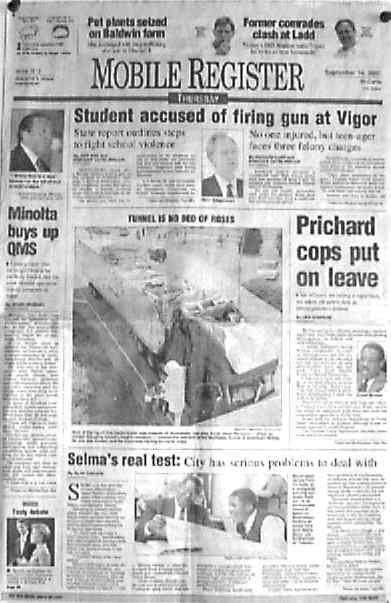
Prichard uncertain where money went Seized cash missing in Prichard 09/09/00 By EDDIE CURRAN
"We have not been able to locate the funds," city attorney Greg Harris acknowledged to Mobile Circuit Judge Herman Thomas. At the hastily called hearing, lawyers for Prichard, the Mobile County district attorney's office and accused drug dealer Frankie Wilson sought to solve the mystery of the missing cash. Prodded by Judge Thomas, the story unfolded through bank records and testimony by Prichard officials. Its increasingly central figure was a neatly groomed, bespectacled man seated in the rear of the courtroom. But Prichard Police Lt. James Stallworth, one of the top ranking officers in the department, wasn't providing any answers. His lawyer, Mobile criminal attorney Buzz Jordan, told Stallworth not to comment. Jordan said Friday afternoon that his client remains a respected officer of the Prichard Police Department, and would be able to clear up the mess once he's provided ac cess to city records, and records seized in August by the FBI during a raid on the Prichard Police Department. A group of FBI agents involved in the investigation watched Friday morning's hearing, but didn't participate. Mobile District Attorney John M. Tyson Jr., who also attended, said the matter of the missing cash was a part of that federal investigation, and an investigation by his office. He declined to comment when asked if those investigations might involve assets seized by Prichard police in other drug cases. Friday morning's hearing involved a civil case, not a criminal charge. Thomas set the hearing to consider a demand by Wilson's lawyer, Mobile attorney Dom Soto, that Prichard be found in contempt of court and be ordered to reimburse Wilson for the $16,000 seized from his home on May 22, 1999. Thomas, with support from Tyson's office, ruled for Soto's client. "I have no choice but to order the City of Prichard, immediately, to return those funds," Thomas said at the conclusion of Friday's hearing. Harris, the Prichard attorney, reminded the court that the city is in bankruptcy. Soto's client would have to take his judgment to bankruptcy court, and get in line with other creditors, Harris said. Late Friday, Prichard deposited $16,000 with the court, and asked Thomas not to hold the city in contempt. The order also asked Thomas not to disperse the money until he receives the blessing of the bankruptcy court, Tyson said. The money might never have been found to be missing had federal prosecutors not dropped cocaine and crack cocaine distribution charges against Wilson. In July, prosecutors acknowledged that Prichard police made critical errors in the search of Wilson's home. Court records show the case against Wilson also was damaged because the lead investigator was former Prichard police Sgt. John Stuckey, who resigned in March amid "allegations of misconduct," city officials said then. Stuckey was to testify against Wilson, but Stuckey's credibility has been tarnished by his resignation and the federal investigation. During the May 22, 1999, search, officers also took two kilos of cocaine from Wilson's home, equipment used to convert powder cocaine to crack, and various electronic equipment, including a computer and two televisions. Prosecutors said they regretted dropping the case against Wilson, but had no alternative. In July 1999, the district attorney's office, acting on behalf of Prichard police, filed what's called a forfeiture action against Wilson. These actions are commonly brought by the district attorney's office as a means of keeping cash, cars or equipment seized in drug raids. But when federal prosecutors dropped their charges against Wilson, the district attorney's office dropped its forfeiture action, since Prichard no longer had any legal ground to keep Wilson's money. Soon after, Soto asked Thomas - who had been assigned the case a year earlier - to order Prichard to return the money to his client. On Aug. 25, Thomas signed such an order. But Prichard officials, including police Chief Sammie Brown, officer Stallworth and city attorney Jackie Jackson, sought to circumvent Thomas's ruling, Thomas, Soto and others said Friday. For example, after Thomas signed the order, Soto contacted Brown to demand the money. The police chief threatened to put Soto in jail, Soto said in court, and in a brief filed Thursday afternoon. "Chief Brown asserted that whoever received the funds would also be given a large amount of cocaine purportedly seized at the residence and would be arrested," Soto wrote in brief to court. At Friday's hearing, Thomas provided an account of the calls and information he had received from Prichard officials in the past week. Thomas was told that Jackson, one of Prichard's lawyers, had told Prichard Municipal Judge Mike Harbin that he had the legal authority to condemn the $16,000 and by so doing, allow it to remain with Prichard. Thomas said that when he learned of this, he called Jackson and asked him to cite the law that gave a municipal court such authority. Jackson acknowledged to Thomas that there was no such law. Attempts to reach Jackson on Friday for comment were unsuccessful. Thomas also said that he was told by Prichard officials that the Mobile district attorney's office planned to appeal Thomas's Aug. 25 order. Thomas said he contacted the district attorney's office, and was told they had no such plans. Brown, who appeared embarrassed by the judge's telling of events, did not deny making that threat but explained to the court that he was acting on information provided to him by Stallworth, and which he believed at the time to be true. Brown reminded the court that the money was seized, and apparently lost, well before he left the Mobile Police Department to lead Prichard's force in January. He reiterated that there is no record of the money having been received by his office. At this point, the focus of the hearing moved from efforts by Prichard to counteract Thomas's order, to testimony about what happened to the money. Jordan, Stallworth's attorney, said that his client had told him that he deposited the $16,000 with Regions Bank last October, in keeping with Prichard's policy. The bank provided Stallworth with a cashier's check, which Stallworth delivered to Dana Allen-Foster, a clerk at Prichard city hall. Thomas then asked Allen-Foster - now Prichard's acting finance director - if she had any record of receiving a $16,000 cashier's check. Allen-Foster said she had diligently searched and found no such check. Jordan then told Thomas that, according to Stallworth, the $16,000 in cash was deposited along with other seized funds, totaling $28,724. Thomas asked Allen-Foster if she was aware of a deposit in that amount. Allen-Foster provided Thomas with copies of a cashier's check in that amount. She explained that, as required, Stallworth had also provided forfeiture orders, signed by Harbin. Each order listed a person's name, and the amount seized. One such order showed an amount in excess of $14,000, but was taken from a defendant other than Harris. No other order - and there were more than 100 of them - showed an amount greater than $1,000. Most were for amounts less than $50, court records show. Soto, seeing the hearing turn into an attempt to solve the mystery of the missing money, reminded Thomas that his client didn't care what happened to the money. "We don't particularly care what pot it comes from. The city can comply today by writing a check," Soto said. Harris, the Prichard attorney, argued that the city had no record of receiving the money. Soto noted that when the district attorney's office filed the forfeiture action in July 1999, it listed the amount of money seized by Prichard and specifically identified the items of electric equipment, which included a computer and two televisions. Harris responded that the forfeiture claim was brought by the district attorney's office, and not the city of Prichard. But that gambit didn't fly. Assistant District Attorney Nicki Patterson reminded Thomas that her office only brought the forfeiture action after being asked to do so by the Prichard police. Shortly thereafter, Thomas ordered Prichard to pay the money. |